How to Take the Car Barge from St. Thomas to St. John
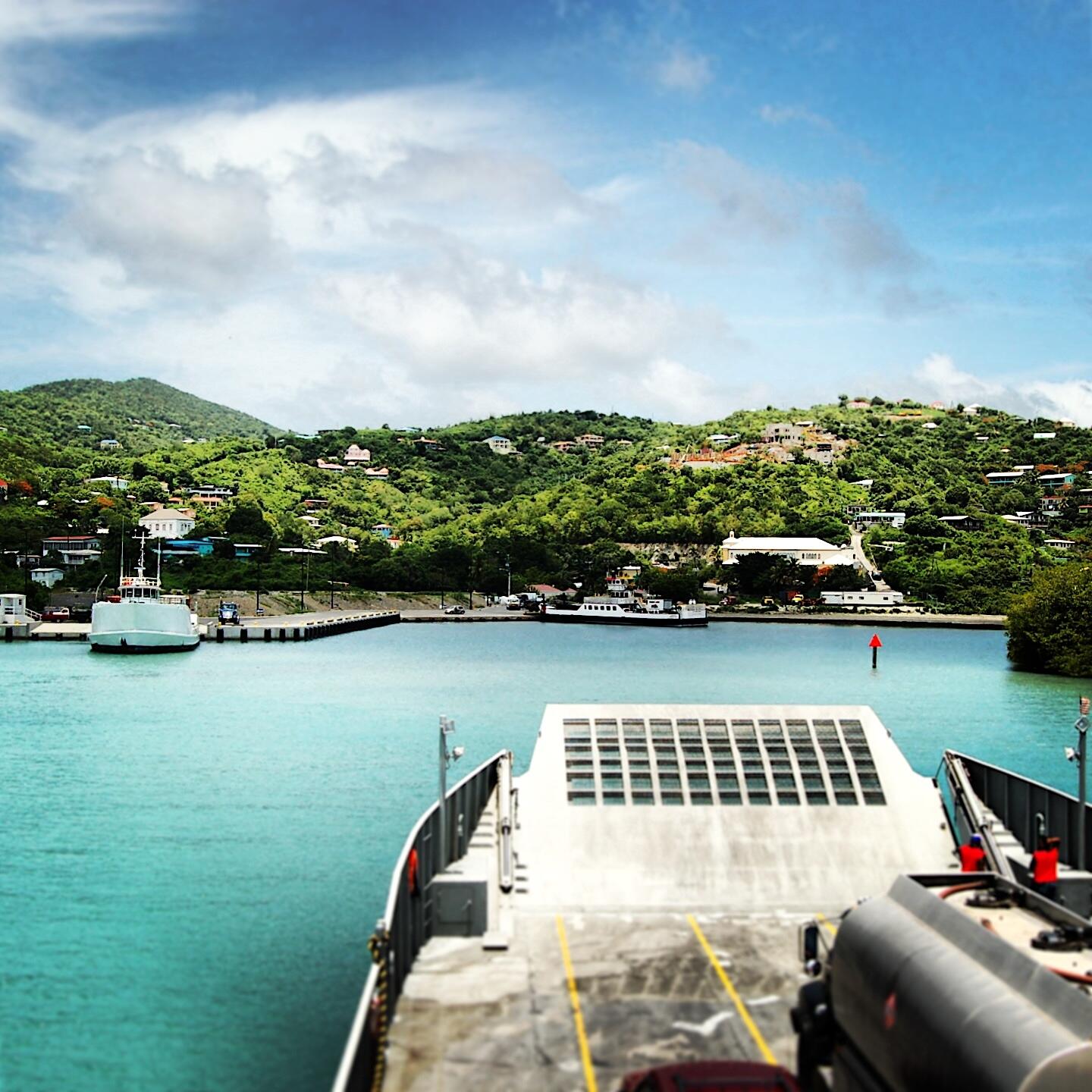
The car barge between Red Hook, St. Thomas and Enighed Pond, St. John is a working freight ferry that also carries tourists. Two companies run it, both take online reservations, and both will happily load you if you just show up and queue. Understanding which of those two things you're doing — and what a reservation actually buys you — is most of what first-timers get wrong.
It is also the only way to get a vehicle to St. John.
Read this before anything else: your rental car probably can't go
The most expensive mistake on this page is assuming you can put a St. Thomas rental car on the barge.
Most major rental agencies operating out of Cyril E. King Airport (STT) prohibit taking their vehicles off St. Thomas. It is in the contract. The barge crew will not check, and will happily load you — the barge company is not your rental company. But if the car is damaged, breaks down, or is involved in anything on St. John, you are outside the rental agreement and outside the insurance that came with it.
Policies vary by agency and by franchise location, and they change. Do not rely on a forum post from 2011, and do not rely on this page. Call the specific location you're renting from and get the answer in writing before you book.
The alternative most people should take: leave the car on St. Thomas, take the passenger ferry from Red Hook to Cruz Bay, and rent a Jeep on St. John from a St. John company. St. John rental agencies expect their vehicles to be on St. John. You skip the barge entirely, you skip the queue, and in most cases you spend less.
The barge makes sense when you are moving your own car, moving a rental from a company that has explicitly cleared it, moving a lot of gear, or staying long enough that the round-trip cost beats a second rental.
The route
One route, two ends:
- Red Hook, St. Thomas — officially the Urman Victor Fredericks Marine Terminal, on Route 32. Passenger ferries and car barges both operate out of this location, but from two separate docking areas with separate marked entrances. If you follow signs for the passenger ferry with a vehicle, you're in the wrong line.
- Enighed Pond, St. John — officially the Theovald Eric Moorehead Marine Facility, on Relis Street. It's the commercial port on the south side of Cruz Bay, roughly a five-to-ten minute walk from Cruz Bay center, and it is not where the passenger ferry lands.
Crossing time is short — plan on 25 to 30 minutes on the water. Your total time is dominated by staging and loading, not by the crossing.
The operators
Two companies currently run the route. They do not coordinate schedules with each other, they do not sell each other's tickets, and a round-trip stub from one is not honored by the other.
| Operator | Phone | Booking | Notes |
|---|---|---|---|
| Big Red Barge | (340) 227-0918 | bigredbarge.co | Daily service. 24-vehicle capacity, stern loading ramp — you back on, crew guiding. |
| Love City Car Ferries | (340) 779-4000 | lovecitycarferries.com | Daily service. Reservations only for on-the-hour sailings, and only one day or more ahead. |
A third company, Global Marine's Tug Life, ran this route for years and still appears on a lot of travel sites. We can't confirm it's currently operating. If a third schedule matters to your planning, call (340) 642-8893 before you build a day around it.
Schedules shift with season, demand, holidays, and drydock, and both operators publish theirs on their own sites. Treat any printed schedule — including ours — as a starting point and confirm the day before you travel.
How it actually works
Reservations exist, but they aren't a line pass. Both operators sell online. What you're buying is a place on a specific sailing's manifest, not permission to arrive late. You still stage in the vehicle queue at the ramp, you still check in ahead of departure, and a no-show forfeits the fare. Two quirks worth knowing: Love City won't sell you a reservation for the same day — one day out minimum — and Love City reservations are only offered for on-the-hour departures, so their half-past sailings are walk-up only. If you decide at breakfast to cross at noon, you're queueing, reservation system or not.
Check in 30 minutes before departure. Both operators say 30 minutes; Love City says 45 during peak season and holidays. That's not padding — it's the window in which your reserved slot is actually held.
Without a reservation, you're first-come, first-served. Walk-up traffic loads at the captain's discretion, on the basis of what's left after the manifest and how the weight works out. In high season that's a real risk, not a formality.
You queue in your vehicle. Get in the line at the ramp and stay in it. Don't leave the vehicle unattended to go get coffee; the line moves in surges and a gap means the loader waves the car behind you forward.
A barge holds a limited number of vehicles. Big Red Barge carries up to 24. If you're past the cutoff, you wait for the next one.
Paying is not a cash-only affair anymore. Book online with a card, or pay at the dock — Love City lists cash, Visa, MasterCard, American Express, Discover, debit, and traveler's checks. Carrying some cash is still sensible on an island where card readers have opinions, but the old "bring cash or don't board" advice is out of date.
Virgin Islands Port Authority staff run the dock; the barge crew runs the boat. VIPA directs vehicles on the pier, then the operator's crew takes over and loads. Follow instructions immediately and don't improvise — they load to a weight distribution plan.
You don't have to sit in your car. Once you're loaded and secured, you can get out and go up on deck. Vehicles disembark in reverse loading order, so if you board first you'll leave last.
Timing: when the queue is bad
This is the practical knowledge that isn't on the schedule.
- Sunday afternoon and evening, St. John to St. Thomas. Weekenders going home. This is the reliably worst direction/time combination.
- Friday afternoon, St. Thomas to St. John. Same thing, inbound.
- The last barge of the day, either direction. If you miss it, you are staying overnight on the wrong island with your car. There is no late option, no matter how much you offer to pay.
- Holidays and Carnival. Reduced schedules plus increased demand. Love City runs a limited holiday schedule on Thanksgiving, Christmas Day, and New Year's Day, and its earliest morning departures don't operate on weekends or major holidays at all.
- The morning after a big weather event. Barges don't run in heavy seas, and when service resumes the backlog is enormous.
A reservation insulates you from most of this. It does not insulate you from the check-in window.
What it costs
Both operators charge the same for a standard vehicle:
| Fare | Price |
|---|---|
| Car, SUV, or small truck — one way | $65 |
| Car, SUV, or small truck — round trip | $80 |
| Motorcycle — one way / round trip (Big Red Barge) | $15 / $25 |
| Senior 65+ with valid ID (Big Red Barge) | $60 |
| After-hours sailing (Love City) | $100 |
Three things people get wrong about the money:
- Buy round trip. Two one-way tickets cost $130. A round trip costs $80. Both operators say return tickets don't expire, so the usual argument for one-ways — schedule flexibility — costs you $50 to buy something you already have.
- The round trip locks you to one company. That's the real trade-off, not expiry. If you buy round trip with one operator, you're returning on that operator's schedule. With two of them running the route, that's a narrower set of departures than you might assume.
- Do the math against a second rental. For a week-long stay, $80 round trip plus a St. Thomas rental sitting unused on days you're on St. John frequently exceeds simply renting on each island as needed — before you even account for the rental agreement problem above.
If you're bringing a rental you have cleared
- Photograph the vehicle thoroughly before boarding. Barge decks are steel, salt-wet, and tightly packed. Door dings happen — and the operators' terms of carriage disclaim liability for damage to vehicles both onboard and in the terminal berthing areas.
- Fold your mirrors.
- Know your vehicle's clearance. The ramp angle at low tide is steeper than it looks and low-slung cars scrape.
- Don't leave anything visible in the vehicle.
- Bring the driver's license. Both operators can ask for government-issued photo ID at boarding.
Passengers
Passengers ride the barge with the vehicle at no extra charge, which changes the calculation for groups. Four people with luggage on the passenger ferry runs somewhere between $26 and $49 each way depending on ages and how many bags you're paying for. On the barge, those four people are already inside the $65.
For a solo non-driver, though, there's still no reason to sit in a vehicle queue. Send the driver on the barge and everyone else on the passenger ferry, then meet in Cruz Bay — the barge lands at Enighed Pond, the passenger ferry lands at the Cruz Bay dock, and they're a short walk apart.
What changes and when
Barge schedules and fares in the USVI are not stable. Operators come and go, boats go into drydock, hurricane season disrupts everything, and fares move without much notice. Specifically watch for:
- Fare changes — usually announced with little lead time
- Schedule changes — most common at the shoulder-season boundaries and around holidays
- Operator changes — companies on this route have started, stopped, and changed hands repeatedly, and travel sites are slow to notice
Call the operator directly the day before you travel. If you find something on this page that's out of date, tell us — that's how we keep it right.
Frequently Asked Questions
Can I take my St. Thomas rental car on the car barge to St. John?
Usually not without checking first. Most major rental agencies at Cyril E. King Airport prohibit taking their vehicles off St. Thomas, even though the barge operators themselves won't stop you from loading one. Call your specific rental location and get confirmation in writing before you plan around it.
Do I need a reservation for the car barge?
No, but you should have one in high season. Both operating companies book online. A reservation holds a place on a specific sailing; it does not let you skip the vehicle queue or arrive late — plan on checking in 30 minutes before departure, 45 during peak season. Love City requires reservations at least one day ahead and only for on-the-hour departures, so same-day travel means queueing regardless.
Should I buy a round trip or two one-way barge tickets?
Round trip, in almost every case. A round trip costs $80 while two one-way tickets cost $130, and both operators state that return tickets don't expire. The real trade-off isn't expiry — it's that a round-trip stub is tied to the company that sold it, so you're committing to that operator's return schedule.
Is a round-trip barge ticket valid on a different operator?
No. Round-trip fares are tied to the specific operator you bought from — a return stub from one company isn't honored by another.
What happens if I miss the last barge of the day?
You're stranded on the wrong island overnight with your vehicle. There's no late option regardless of how much you're willing to pay, so build in a real time buffer, especially on Sunday afternoons and evenings.
Can passengers ride the car barge without a vehicle?
Passengers ride free with a vehicle, which makes the barge cheaper than the passenger ferry for a family of four once bag fees are counted. Riding without a vehicle isn't worth it — the passenger ferry is faster, more frequent, and more comfortable. The two docks are a short walk apart in Cruz Bay.